

Arsenal, Manchester City and the Modern Game’s Creativity Problem
Was the Carabao Cup Final the marker for how football is moving at the very top level.
David Hole
3/25/20267 min read
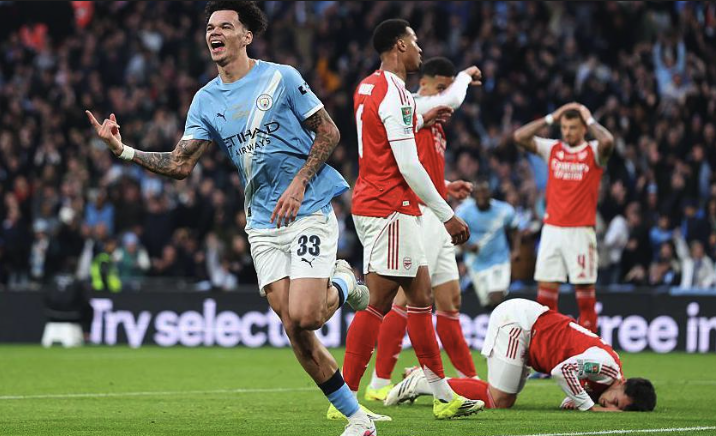
Arsenal’s 2–0 Carabao Cup final defeat to Manchester City was not just about a goalkeeping error or a bad second half. It exposed a deeper tactical problem on Arsenal’s side, and raised a wider question about elite football itself: in a game now saturated with analysis, planning and structure, are the biggest teams starting to cancel the life out of each other?
Arsenal did not just lose a cup final at Wembley. They lost a tactical argument.
That is the uncomfortable truth of this 2–0 defeat to Manchester City on Sunday 22 March. Yes, the immediate talking point will be Kepa Arrizabalaga’s error for the first goal, and fairly so. Yes, there will be criticism of Mikel Arteta’s decision to keep faith with the goalkeeper who had played through the competition. But if that is where the analysis begins and ends, it misses the larger point. Arsenal were beaten by a side that solved the game better, controlled the second half better, and imposed a more coherent tactical order on the contest. Nico O’Reilly’s two second-half goals settled it, but the pattern had been shifting before the finishing blows arrived.
That should worry Arsenal. Yet it should also worry football more broadly.
Because this final raised a bigger question than who lifted the trophy: with clubs now armed with armies of analysts, tactical coaches, opposition dossiers and specialist support staff, is elite football beginning to coach the life out of itself? Are the biggest sides becoming so well-drilled, so risk-managed and so extensively prepared that they are increasingly cancelling each other out? And when that happens, what is left of flair, surprise and real entertainment value?
Arsenal began well, but never made the game theirs
There was an early spell when Arsenal looked sharp enough to believe this was their day. Kai Havertz was denied by James Trafford, Bukayo Saka threatened, and City had to withstand a period of genuine pressure before they settled. Arsenal were energetic, aggressive and capable of unsettling City in the opening phase.
However, good starts do not win finals. Control does.
That is one of the hardest lessons in elite football. Many major games begin with noise, adrenaline and momentum. The better sides are often the ones who survive that first wave without losing their shape or their nerve. City did exactly that. Once Arsenal’s early surge faded, Guardiola’s side began to impose calmer forms of authority: better possession, better spacing, better management of territory, and far more command over the rhythm of the game. By full time, the Guardian’s live analysis was calling Arsenal “conservative” and “lacklustre,” which felt harsh in tone but broadly fair in substance.
And Arsenal, crucially, never really interrupted that shift.
City found the pattern. Arsenal did not disrupt it
This is where the final turned from a contest into a lesson.
For all of Arsenal’s progress under Arteta, there are still matches in which the team can become too obedient to its own structure. Too careful. Too convinced that if the shape remains sound, the game will eventually tilt back in their favour. Yet football does not always work like that. Sometimes structure is not the answer. Sometimes structure becomes the trap.
Once City settled, they began to dictate the emotional temperature of the game. The contest became less frantic and more managed. Arsenal were no longer attacking space with conviction; they were increasingly reacting to City’s spacing, City’s circulation and City’s control of territory. O’Reilly’s two goals, in the 60th and 64th minutes, merely confirmed a pattern that had already become visible. Arsenal had lost the initiative and did not have the tactical or emotional response to take it back.
That is the part that should concern Arteta most.
The problem was not simply that City improved. It was that Arsenal did not inject enough disorder once City had established the game on their own terms. There was too little unpredictability, too little sense that Arsenal were prepared to break their own patterns to break City’s. Too few moments where the match felt as though it might be dragged somewhere uncomfortable for Guardiola’s side.
Arsenal’s missing connector was impossible to ignore
This is where the personnel issue becomes central.
What Arsenal lacked in this final was not simply “creativity” in the vague, decorative sense. They lacked a connector. With Eberechi Eze absent through injury and Martin Ødegaard a pre-match fitness doubt who did not feature, Arsenal were missing the kind of player who can receive under pressure, turn the game forward and connect defence to midfield with clarity and tempo. Arsenal were also without Eze for the final, with Sky Sports and other reporting flagging his calf injury as a significant blow not just for the final but for the foreseeable future run in.
City, by contrast, had Bernardo Silva.
He was not simply tidy. He was functional in the most important way. He offered angles, linked phases and helped City move from defence into midfield and from midfield into attack without losing rhythm. Arsenal had no equivalent presence in the starting side. Instead, they were asking a semi-fit Havertz, back in the side after a long lay-off, to do connective work that depends on sharpness, repeat involvement and tempo. He was some way short of his best, and Arsenal’s build-up suffered for it. Havertz did start and was involved in Arsenal’s better early moments, but the game increasingly passed around him rather than through him.
That mattered tactically because it left Arsenal with a broken chain. Too often the deeper line could circulate possession without finding the next clean connection into the game’s decisive spaces. The result was a side that either played safely in front of City or tried to jump lines too quickly without proper control in between. When that happens, a team can look busy without looking coherent. Against a Guardiola side, that is fatal.
This, more than anything, is why Arsenal’s “creativity problem” in this final should not be reduced to flair alone. It was about connection. It was about who could join the game up. City had that player. Arsenal did not.
Kepa’s error changed the scoreline. It should not hide the real failure
Of course the goalkeeping decision matters. It mattered before kick-off and it mattered even more once Kepa failed to deal with the cross that led to O’Reilly’s opener. That moment changed the emotional balance of the game and pushed Arsenal into a far more difficult position.
But the deeper issue is not simply that Arsenal chose the wrong goalkeeper. It is that one mistake was enough to send the whole contest slipping away.
Top sides recover. Top sides reset. Top sides force the opponent to solve a new problem.
Arsenal did not do that. They looked wounded by the opener and vulnerable almost immediately after it. For a side with title ambitions and real European aspirations, that is the more troubling diagnosis. The collective reaction was too passive. City sensed it, and once City sense passivity, they are ruthless in making you live inside it.
When analysis meets analysis, football can become strangely bloodless
This is the wider question, and it is not only about Arsenal.
Modern football is more informed than it has ever been. Every pressing trigger is studied. Every opposition weakness is clipped, tagged and rehearsed. Every rest-defence shape is reviewed. Every build-up pattern is analysed in advance. The game is richer in information, more sophisticated in preparation and far more advanced in its understanding of space.
That is progress. But the paradox is that progress can come at a cost.
When both teams are heavily coached, meticulously analysed and obsessively prepared for each other’s strengths, the spectacle can shrink. Risk gets filtered out. Spontaneity gets reduced. Players become more positionally secure but, at times, less expressive. Every zone is covered, every overload anticipated, every transition managed at source. Matches can drift into a kind of mutual tactical suffocation where both sides are so aware of danger that they become hesitant to create any.
This is exactly what happened in the first 60 mins of the Carabao cup final. City worked out Arsenal, worked out that they had little creativity going forward and smartly suffocated Bukayo Saka with two and sometimes three players stopping any chance of openings being created.
That is not always bad football. Often it is very clever football. But clever is not always compelling.
And finals are especially vulnerable to this trend because the fear of error becomes even greater. Nobody wants to be the side that opens the wrong lane, leaves the wrong space or loses the wrong duel in transition. So coaches seek control. Players seek safety. Possession becomes tidier, distances become shorter, and the match can begin to feel less like a sport at full expression and more like a carefully managed avoidance of catastrophe.
The best teams still need players trusted to disturb the script
That is why Arsenal’s absences mattered so much.
Without Eze, without Ødegaard in the starting side, and with Havertz short of full sharpness, Arsenal lacked the one-touch clarity and connective play needed to pull City’s structure apart. This was bound up with personnel as much as mentality. It was not simply that Arsenal became cautious; it was that they did not have enough of the right profiles on the pitch to reclaim the game once City had established control.
And that is where the broader argument comes in. The danger for the modern game is not that coaching exists, or that analysis has improved standards. The danger is that coaches become so focused on preventing disorder that they also prevent invention. The very things that make football thrilling — the unexpected dribble, the quick risk between the lines, the pass that breaks the script rather than follows it — can start to feel like deviations from the plan rather than the point of the game itself.
Arsenal fell into that trap here. Once City had settled, Arsenal increasingly played like a side trying not to lose control rather than one capable of reclaiming it. There is an enormous difference between those two mindsets. One preserves shape. The other changes games.
This was not only a lost final. It was a glimpse of a wider problem
Arsenal got the final wrong. They began well, but did not sustain superiority. They made a major selection call that backfired. They allowed City to establish the match pattern. And when the contest demanded disruption, they did not provide enough of it.
Yet the bigger issue is that this was not merely Arsenal-specific. It reflected something broader about what the game is becoming.
Football has never been more studied. It has never been more organised. Never been more staffed. And still the question lingers: in the rush to optimise everything, are clubs now in danger of optimising away the very unpredictability that makes the sport worth watching?
How many players do you currently see in the Premier League who beat an opponent with the ball and dribble to try and beat a second or a third? You could probably come up with a few names, but you won't be picking a team of 11 of them because the trait at the moment is not to turn over possession.
Arsenal’s defeat at Wembley does not answer that question on its own. But it sharpens it.
Because when two elite teams meet and one gradually neutralises the other not through brilliance alone, but through superior control, superior management of moments and superior tactical suffocation, you cannot help but wonder where the game is heading.
The modern game is smarter than ever.
The concern is that it may also be becoming a bit too smart for its own good.