

Control is not the same as authority.
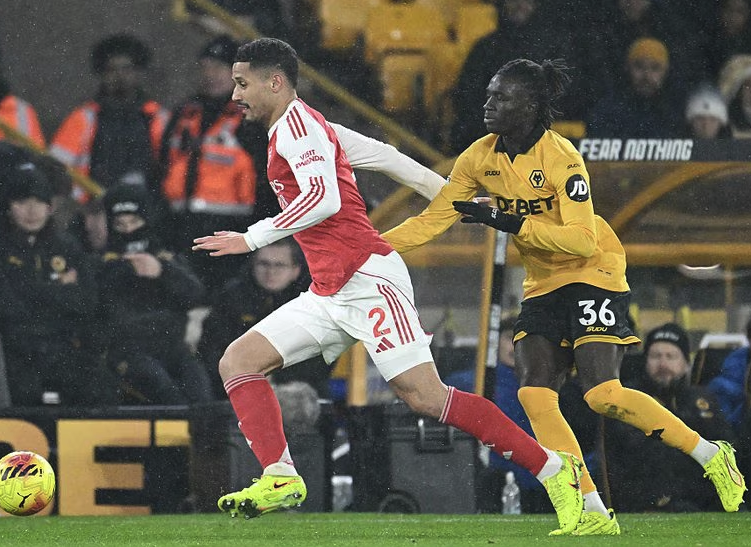
Arsenal’s Failure to Accelerate Is Costing Them Arsenal did not drop points against Wolves because of chaos. They dropped them because of restraint. Two goals ahead in a Premier League fixture, in control of territory, tempo and progression, this was a game that required one thing above all else: escalation. Instead, Arsenal regulated. They circulated. They managed. And in doing so, they allowed oxygen back into a contest that should have been suffocated.
David Hole
2/20/20264 min read
Control Is Not the Same as Authority
Arsenal’s Failure to Accelerate Is Costing Them
Arsenal did not drop points against Wolves because of chaos.
They dropped them because of restraint.
Two goals ahead in a Premier League fixture, in control of territory, tempo and progression, this was a game that required one thing above all else: escalation. Instead, Arsenal regulated. They circulated. They managed. And in doing so, they allowed oxygen back into a contest that should have been suffocated.
The 2–2 draw — sealed deep into stoppage time — felt like a punch to the ribs. But it was not random. It was the predictable consequence of a side that still struggles to “go for the throat” when game state demands it.
This is not about panic. It is about pace.
At 2–0, the match had tilted decisively. Wolves were stretched. Their midfield distances were growing. The crowd sensed vulnerability. The third goal was there to be claimed.
Instead of increasing verticality, Arsenal retreated into risk management. Full-backs recycled rather than overlapped aggressively. Midfielders chose safe progression over line-breaking incision. The tempo softened.
The paradox of control is that it can become passive and this only lasted barely 10 mins before Wolves pegged a goal back.
Elite teams recognise moments of fragility in opponents. They detect when a defensive block is destabilised and apply further stress. Arsenal, too often, choose to stabilise themselves instead.
That is not a defensive flaw. It is a competitive one.
When Wolves clawed their way back — culminating in that stoppage-time equaliser — the late drama obscured the larger truth. Arsenal had spent significant periods after going 2–0 up inviting variance back into the game.
Arsenal’s identity under Arteta is built on structure, spacing and discipline. They are one of the league’s most organised sides in possession. They limit transitions. They compress space.
But control is not the same as authority.
Authority requires tempo modulation — the ability not just to calm games, but to accelerate them decisively. Manchester City at their peak would score the third and fourth when opponents wobbled. Liverpool under Klopp would overwhelm in waves. The match would move from competitive to terminal in 15-minute bursts.
Arsenal rarely produce those bursts.
They dominate without devastating.
That distinction matters in title races.
The Wolves draw is not isolated.
There have been multiple occasions this season where Arsenal have taken leads against lower or mid-table opposition and failed to convert superiority into separation. Wins have been narrower than they needed to be. Margins have remained thin. Anxiety has lingered longer than it should.
Instead of 3–0 or 4–0 afternoons that extinguish hope and pad goal difference, Arsenal’s victories often remain alive until the final whistle.
This approach keeps matches technically under control. It does not remove jeopardy.
And when you repeatedly leave matches within one moment of reversal, eventually one of those moments arrives.
Previous Seasons: A Familiar Fault Line
This tendency is not new.
In prior title pursuits, Arsenal have reached decisive spring phases with momentum — only to tighten when acceleration was required. Games that demanded emotional surge were treated with structural caution. Leads were protected rather than expanded.
Rather than driving toward the finishing line, Arsenal have sometimes moderated their stride.
The effect is cumulative. Rivals sense it. Opponents remain alive longer than they should. Pressure compounds internally rather than being displaced outward. This is not something that last season can be suggested as a failing but in previous years this has been evidential.
Championship-level sides cling on. Top-four rivals survive. Title competitors close gaps.
The inability to create daylight becomes self-reinforcing.
Tactical Roots: Why Escalation Stalls
Why does this happen?
First, Arsenal’s midfield is calibrated for control rather than chaos. It prioritises positioning over spontaneity. That has defensive benefits. But when leading, it can limit unpredictability.
Second, the full-back system — often inverted to protect central zones — secures structure but reduces sustained width-driven overloads late in games. When ahead, Arsenal do not always stretch the pitch aggressively enough to force defensive collapse.
Third, risk tolerance narrows with advantage. Players become preservation-minded. Instead of sensing vulnerability in the opponent, they sense danger in conceding.
The psychology flips.
Elite sides impose fear. Arsenal occasionally internalise it.
Look at the scorelines against lower-placed teams this season. How many matches have Arsenal put beyond doubt before the final 20 minutes? How many afternoons have ended in total detachment — opponent deflated, substitutions comfortable, crowd celebratory rather than anxious?
These have been wins. Important ones. But not enough emphatic conclusions.
Crushing victories do more than add goal difference. They build psychological insulation. They allow rotation. They create inevitability.
Arsenal, for all their quality, remain negotiable.
What “Going for the Throat” Actually Means
This phrase does not mean abandoning structure. It means recognising game-state opportunity.
When two goals up:
Increase vertical passing frequency.
Overload weak-side channels.
Sustain counter-press intensity rather than settling into positional control.
Maintain attacking intent through substitutions rather than defensive consolidation.
It is not recklessness. It is competitive instinct.
Wolves, at 2–0 down, were destabilised. That was the moment to accelerate. Instead, Arsenal de-escalated.
The equaliser was dramatic. The underlying pattern was gradual.
The Final Evolution Required
This Arsenal side is close. Structurally coherent. Technically strong. Defensively resilient.
But the next step in their evolution is not tactical sophistication. It is competitive acceleration.
Managing games is the behaviour of contenders protecting advantage.
Killing games is the behaviour of champions asserting dominance.
Against Wolves, at 2–0, the match required finality. Arsenal chose regulation. They paid for it with two dropped points.
If the objective is not merely qualification, not merely respectability, but genuine title authority, then the standard must rise.
Elite teams do not allow late narratives to form. They extinguish them long before stoppage time.
Until Arsenal learn to overwhelm — not just outplay — they will continue to find themselves in games that should already be over.
And in this league, that distinction is everything.