

Derby Discipline
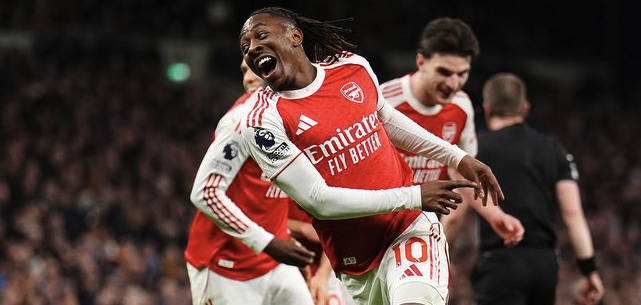
Arsenal dismantled Tottenham 4–1 in the North London Derby. It was emphatic, controlled, and — if we’re being honest — could have been heavier. But grown-up title races are not built on emotion. They are built on logistics, recovery cycles, fixture sequencing, and psychological steadiness. So the real question after this derby isn’t “Was that a statement?”
David Hole
2/23/20264 min read
Derby Euphoria Means Nothing Without Logistical Discipline
Arsenal dismantled Tottenham 4–1 in the North London Derby. It was emphatic, controlled, and — if we’re being honest — could have been heavier.
But grown-up title races are not built on emotion. They are built on logistics, recovery cycles, fixture sequencing, and psychological steadiness.
So the real question after this derby isn’t “Was that a statement?”
It’s this: With ten games to go, are Arsenal better positioned than Manchester City over the next six weeks?
Because that is where this title will bend.
The Derby: Impressive, But Context Matters
Arsenal were excellent. Spurs were abject. Both truths can sit comfortably together.
This was not a clash between two high-functioning elite sides. It was a top-of-the-table contender dismantling a team currently sitting 16th and flirting with genuine relegation anxiety.
Tottenham were passive without the ball, incoherent in transition, and structurally brittle once they conceded. Arsenal didn’t have to suffer for this win — they imposed themselves.
And that matters.
A “statement win” usually involves overcoming resistance. This was a demonstration of difference.
The difference was not just talent. It was organisation. It was clarity. It was belief versus doubt.
The scoreline flatters Spurs.
The Six-Week Equation: Arsenal vs Manchester City
Now we separate emotion from structure.
First, the correction that changes the shape of the run-in:
March 22 is not a league fixture. It is the Carabao Cup Final at Wembley between Arsenal and Manchester City.
That distinction matters enormously.
Wembley is a neutral venue. It is a one-off event. It carries emotional and physical cost — but it does not directly move the league table.
The true league hinge between the two clubs comes later, when Arsenal travel to the Etihad in mid-April.
So the next six weeks contain:
Domestic league accumulation
A cup final at Wembley
Recovery from that final
And positioning ahead of the Etihad league meeting
That is a complex logistical puzzle.
Arsenal’s Immediate League Run
Arsenal’s upcoming league fixtures are:
Chelsea (H)
Brighton (A)
Everton (H)
Bournemouth (H)
From a travel standpoint, apart from a day trip to Brighton. Three home fixtures. Two away trips including the FA CUP to Mansfield, its not even an issue.
From a difficulty standpoint, it is more nuanced.
Chelsea and Brighton can punish slow tempo and positional laziness. Everton will attempt to turn the match into an aerial and second-ball war. Bournemouth could be anything but an easy home game..
These are not glamorous fixtures. They are professional tests.
And professional tests win titles.
Manchester City’s Comparable Stretch
City’s schedule over the same period contains a higher away-game density, including trips that demand physical control and composure under pressure.
Historically, City cope with fixture congestion better than anyone because their squad absorbs rotation without dramatic drop-off.
This is where the structural question emerges:
City’s advantage: depth and experience in multi-front competition.
Arsenal’s advantage: coherence, defined roles, and the psychological uplift of leading the table with a large squad of players who all intersect within the overall team plan.
The Carabao Cup Final adds a shared stress event. Wembley demands emotional intensity, media obligation, and potentially 120 minutes, and it may be that the aftermath of that final — not the final itself — could shape the following league weekend.
The team that compartmentalises better will benefit.
The league meeting at the Etihad in April is the true pivot.
The key for Arsenal is simple: arrive there with margin.
If Arsenal reach Manchester still leading by a meaningful cushion, the psychological equation shifts. If they arrive level or behind, the burden changes entirely.
So the next six weeks are not about beating City directly.
They are about building insulation.
City’s squad depth traditionally allows Guardiola to rotate without compromising system identity. Arsenal’s strength lies less in numbers and more in clarity of automatisms.
Arsenal look at their best when:
The front five are synchronized in pressing triggers.
The midfield spacing is disciplined.
The striker occupies centre-backs consistently.
Injury margin remains the variable neither side can predict.
The final ten matches often come down not to brilliance, but to availability and the ability to grind out results.
Gyökeres: Integration or Illusion?
The derby brace inevitably accelerates the conversation.
Is Gyökeres fitting into Arsenal’s pattern — or was this simply a “flat-track” performance against a collapsing Spurs side? The fact that Spurs’ centre-backs were forced to engage physically made a significant difference that alone changes how Arsenal’s wide players operate. Gyökeres also broght a level of simplicity without the usual overthinking and hesitation . Arsenal have previously dominated games without converting. Clinical strikers alter game-state control.
He provides an outlet when Arsenal need to reset and go long under pressure.
These are system-compatible traits but it would be amiss to not recognise that Spurs were structurally poor. This was not an elite defensive block denying space performance from Spurs.
Against better sides, Arsenal’s striker must coordinate the first line of pressure flawlessly. One derby does not prove sustained tactical integration.
How does he operate when Arsenal are pinned deeper? When touches are limited? When defenders don’t panic The verdict is not in. But the signs are encouraging. And crucially: confidence in a striker compounds.
Tottenham’s Position: Could They Finish Fourth From Bottom?
It sounds provocative. It isn’t.
Spurs sit 16th. Their cushion over the bottom three is not expansive. Their away fixtures include multiple top-half opponents.
The deeper concern is psychological, not mathematical.
They look like a side waiting for adversity rather than confronting it. That mindset in March and April can become self-fulfilling.
Will they be relegated? That remains unlikely.
Could they finish 17th — fourth from bottom? Yes, structurally it is plausible if current form persists and their tougher fixtures go as expected.
This is what happens when squad building lacks coherence and managerial cycles fail to stabilise performance standards.
Identity without execution is hollow.
So Was It a Statement?
Yes — but not in the way social media frames it.
It was a statement about competence. About levels. About structural superiority.
It was not definitive proof of title inevitability.
The real statement will be made quietly over the next six weeks:
Win the matches that demand professionalism.
Manage the Wembley emotional spike.
Arrive at the Etihad with margin.
Keep the squad intact.
Derbies are theatre. Titles are accumulation. Arsenal have earned the applause. Now they must earn the arithmetic.