

How Premier League Wealth Is Rewriting the Champions League
The San Siro is supposed to remind English clubs where they are. History hangs heavy there. European Cups were won before television money rewired the sport, before financial gravity tilted decisively west. And yet Arsenal’s visit to Inter Milan on Tuesday night felt less like a pilgrimage and more like a routine inspection. Serious, demanding, but familiar. That, in itself, tells you where the Champions League now sits.
1/23/20264 min read
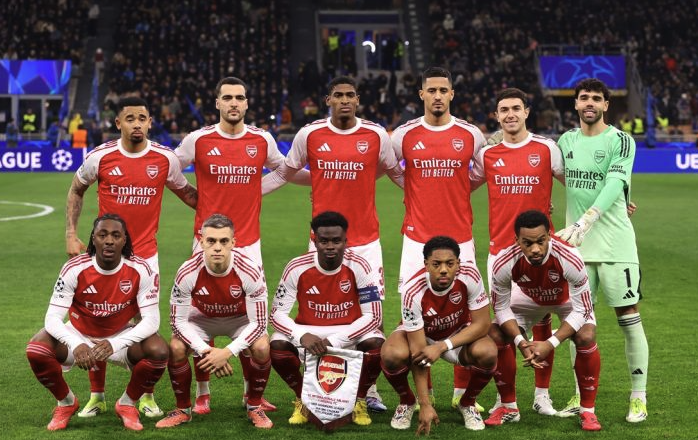
The San Siro is supposed to remind English clubs where they are. History hangs heavy there. European Cups were won before television money rewired the sport, before financial gravity tilted decisively west. And yet Arsenal’s visit to Inter Milan on Tuesday night felt less like a pilgrimage and more like a routine inspection. Serious, demanding, but familiar. That, in itself, tells you where the Champions League now sits.
The competition still trades on heritage and anthem-led theatre. But structurally, it is changing shape. Quietly, persistently, and in ways that are no longer easy to ignore. The Premier League’s financial dominance is not just influencing outcomes; it is reshaping the very nature of the tournament. Increasingly, the Champions League resembles a continental FA Cup — open in theory, but weighted heavily towards those with the deepest pockets, the broadest squads, and the highest baseline quality. More often than not, that means England.
Inter vs Arsenal should feel rare. It once did. Italian tactical authority versus English urgency: different footballing cultures colliding. But this version of Arsenal travels differently. Not just in confidence, but in infrastructure.
They arrive with a squad built to absorb injuries, rotate without collapse, and maintain intensity across competitions. That is not unique to Arsenal. Manchester City, Liverpool, and increasingly others operate on the same logic. The point is not that Arsenal are richer than Inter in isolation. It is that Arsenal exists inside an ecosystem that guarantees financial resilience year after year, regardless of finishing position, European progress, or domestic wobble.
Inter, for all their pedigree and recent resurgence, still operate within constraints. Player trading matters. Wage ceilings matter. European progress is financially meaningful rather than merely prestigious. That imbalance framed the contest before a ball was kicked.
This is not about single transfer windows or billionaire owners. It is structural. Premier League broadcasting income has created a self-reinforcing flywheel: higher revenues fund deeper squads, which sustain league quality, which enhances global appeal, which in turn inflates broadcasting deals further.
The result is that England’s top five or six clubs now carry Champions League–level squads as a baseline, not an aspiration. The drop-off from the first XI to rotation options is smaller. Injury crises are survivable. Fixture congestion is a nuisance rather than a destabiliser.
In European competition, that matters more than tactical nuance alone. Over long league-style phases or two-legged ties, depth tells. Consistency tells. And increasingly, English clubs are built for accumulation rather than moments.
Five into eight is no longer fanciful.
Against that backdrop, the idea that five Premier League clubs could finish in the Champions League’s top eight is no longer provocative. It is plausible. Perhaps even probable.
Not because English teams are tactically superior across the board, but because they are structurally advantaged over volume. They can navigate rotation-heavy schedules without sacrificing league form. They can field international-calibre players off the bench. They can lose key individuals and remain competitive.
For clubs from Italy, Germany, or even Spain, the margin for error is slimmer. Domestic dominance does not always translate into European depth. A couple of injuries and a poorly timed dip in form, and campaigns unravel quickly. The Champions League, once a crucible of contrasting elites, now increasingly rewards financial durability.
This shift has consequences beyond England’s borders. Well-run clubs elsewhere are being forced into difficult trade-offs. Do you optimise for domestic success or European sustainability? Do you sell at peak value or push one more year and risk financial exposure?
Inter is an instructive example. Organised, competitive, and tactically coherent — yet still swimming upstream in a market where Premier League wages distort recruitment and retention. Their challenge is not incompetence. It is gravity.
Across Europe, the response has been predictable: youth development, selling models, and acceptance that European competition is as much about balance sheets as balance of play. That may be rational. It is not romantic.
For UEFA, this presents a quiet crisis. The Champions League’s commercial value depends on diversity — of winners, styles, and narratives. A tournament that becomes an extension of one domestic league risks narrowing its own appeal.
Yet UEFA’s tools are blunt. Revenue redistribution treats symptoms, not causes. Format changes may shuffle outcomes at the margins, but they do not address wage power, squad depth, or the pull of the Premier League brand.
There is an irony here. The competition’s success has helped create the conditions for its imbalance. English clubs benefit enormously from Champions League exposure, yet their domestic revenues increasingly dwarf continental distributions. UEFA must protect the golden goose without allowing it to dominate the farm.
Whether that is possible remains an open question.
For elite players, the implications are already clear. England now offers the full package: money, competitiveness, exposure, and a credible route to European honours. Spain and Germany still produce excellence but increasingly feel like chapters rather than destinations.
The Champions League used to be the reason players left England. Now, it is something they expect to contest from within it. That alters recruitment dynamics profoundly.
Arsenal’s own trajectory reflects this. Under Arteta, they are no longer pitching for relevance. They are operating as a club that assumes Champions League presence and plans accordingly. That assumption is itself a product of Premier League economics.
Raised stakes for English clubs
Power, however, sharpens scrutiny. Financial dominance removes excuses. If English clubs increasingly populate the latter stages, failure becomes harder to contextualise, and expectations will rise and Standards harden.
For Arsenal, that means European progress is no longer a bonus. It is a benchmark. Squad building, rotation choices, and summer strategy will be judged against what happens in the premier league because in truth, it is harder to win the premier league that the champions league. The Champions league has become an extended FA Cup, throwing up the odd surprise but generally allowing the same top 8 teams to compete in the final rounds pretty much every year.
The paradox is clear: the Premier League’s wealth opens doors, but it also narrows the acceptable margin of underachievement.
A competition at a crossroads
So moving back to Tuesday's game at the San Siro and a grand stadium (albeit about to fall apart) hosting a match that felt important — but not intimidating. And that is the point.
The Champions League is not losing quality, but it is losing uncertainty.
Unless UEFA finds a way to rebalance the economic forces at play, the competition risks becoming predictable in its upper reaches. England and the Premier League will not apologise for that. Nor should it. But the wider game must ask whether dominance, once entrenched, ultimately dulls the spectacle it was built to elevate.
For now, nights like Inter v Arsenal serve as markers. Not of English arrogance, but of structural reality. The Champions League is changing. And it is changing in the image of the Premier League.