

You can't win the title in January, but you can lose it.
Arsenal lost 3–2 to Manchester United at the Emirates on Sunday, 25 January. It was their first home league defeat of the season, and it landed with a thud because it arrived at a moment when the table was compressing. Arsenal remain top, but the lead is now four points, with Manchester City and Aston Villa both close enough to turn one wobble into a run of consequences.
1/26/20265 min read
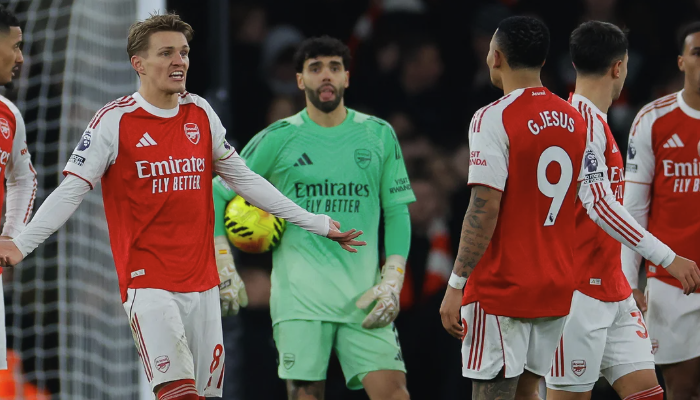
Arsenal lost 3–2 to Manchester United at the Emirates on Sunday, 25 January. It was their first home league defeat of the season, and it landed with a thud because it arrived at a moment when the table was compressing. Arsenal remain top, but the lead is now four points, with Manchester City and Aston Villa both close enough to turn one wobble into a run of consequences.
The performance contained long spells of what Arsenal do well. Yet the result was shaped by what title-winning sides do ruthlessly—managing game state, minimising avoidable chaos, and refusing to let one incident become two.
Arsenal let the match become “events”. United were much better at the events.
For half an hour, it looked like one-way traffic.
Arsenal pressed, squeezed the pitch, and played most of the football in United’s half. ESPN noted 65% possession in that opening spell, with the sort of territorial control that normally translates into either a goal or at least sustained pressure that breaks an opponent’s legs over time.
The opener arrived in a very Arsenal way—right-sided pressure, a delivery into a crowded area, and an own goal credited to Lisandro Martínez under pressure.And then came the key moment of the afternoon: Zubimendi’s attempted backpass that went straight to Bryan Mbeumo, who punished it.
Arsenal can talk about fine margins. They can talk about quality finishing from a distance—Patrick Dorgu’s strike, then Matheus Cunha’s late winner from range.But the uncomfortable truth is simpler: Arsenal didn’t just concede goals. They conceded emotional control. They conceded emotional control. They conceded the feeling of dominance and control over the game.
That is why “title credentials” is the right language here. Not because Arsenal are suddenly not good. They are. But because the title is usually won by the side that suffers a wobble and still emerges with a point, or at least without handing the opponent oxygen.
Mikel Arteta started Gabriel Jesus at centre-forward, with Viktor Gyökeres on the bench.The decision is not hard to defend. Sky’s “Radar” analysis argued that Arsenal can look more fluid with Jesus: more connective tissue, more link play, and more touches in the right places. It’s the version of a striker who helps the whole attack breathe.
Yet this match demanded a different sort of forward influence once the game tilted. United’s centre-backs—Maguire and Martínez—were happy enough dealing with a striker who wants to come to the ball and knit things together. Both Centre halves held a line that practically did not move from 10 yards of their own 18-yard box all game.
So, was it a good move? In principle, yes—if your plan is to dominate possession and score through combination play. In practice, no, because Arsenal didn’t protect the conditions that make Jesus useful. Once the match became stretched, edgy, and transition-heavy, Arsenal needed more running beyond a more direct penalty-box presence to cause those aforementioned centre halves problems.
Jesus can contribute to those things, but he is not the most natural “finish the move” striker in this squad. When the game became frantic, the decision looked less like tactical clarity and more like a gamble that didn’t pay off.
This is where the “lack of pace” up front with Arsenal really bites.
Gabriel Martinelli was available among the substitutes, but he never got on the pitch. Instead, Leandro Trossard started on the left and played 75 minutes.
Trossard is a clever footballer. He finds pockets, combines, and finishes. But he is not Martinelli. He doesn’t scare defenders with repeat sprints in behind. And that changes the geometry of the match. Without that threat on the left, Arsenal’s forward line can become very "on its feet”.
It becomes easier to compress the space between the lines because the defence does not feel constant danger behind its shoulder. That matters especially when the striker is also a connector (Jesus) and when the game is already slipping into a place where the opponent is feeding on your hesitation. This is probably why Ødegard found it very heavy going as the game wore on.
He was involved in the opening goal sequence, and for the first half-hour, Arsenal’s right side looked functional and threatening, but then the match state changed, and so did his influence. Ødegard had flashes of flair but never really managed to take hold of the game before being replaced. In the end, his impact on the match was minimal, and this is where Arsenal should be careful. It’s easy to reduce this to “the captain went missing”. The more accurate reading is that Arsenal’s collective clarity went missing first, and Ødegaard is the type of player who suffers when the team becomes jittery and rushed.
The question for Arsenal is not whether Ødegaard is “good enough”. Of course he is. The question is whether Arsenal has enough alternative routes when its preferred route—structured combinations, controlled possession in the final third—gets disrupted by game state, nerves, and transitions. Sunday suggested they don't.
This is not a critique of Martinelli as some magic solution. It’s a critique of profile balance. In matches like this—against elite opponents, in high-pressure moments—pace isn’t a luxury. It’s a form of control. It forces the other team to defend deeper than they want, creating safer zones for your midfielders to operate in.
Arsenal chose not to deploy it, and United benefited.
At 58 minutes Arteta made four changes in one go: Ben White, Eberechi Eze, Mikel Merino and Viktor Gyökeres all came on, with Hincapié, Ødegaard, Zubimendi and Jesus withdrawn.
It is understandable why. One defender was having a quiet day, the midfield pivot had made the decisive error, the captain’s influence was fading, and the centre-forward hadn’t imposed himself.
But there is a cost to doing it all at once. A football team is not just 11 individuals. It is timings, distances, and shared cues—who jumps to press, who covers behind, who holds the rest of the defence, who receives under pressure, and who runs beyond. When you swap four players simultaneously, you create a mini pre-season in the middle of the match. The new unit needs five minutes to locate itself. Sometimes ten. Against top opposition, that window can decide the match.
Arsenal “had to make changes”, and Arteta made four in one go. Arsenal did generate momentum later. They equalised from a Bukayo Saka corner, with Merino on hand, but three minutes after that emotional release came Cunha’s winner.
That is the sting: Arsenal’s changes did create pressure, but they didn’t restore control. And control is the currency you spend to win titles.
Eberechi Eze replaced Ødegaard at the hour and “failed to influence proceedings”. The job of a bench option in a title race is to settle the team, and bend the match in your direction—either through ball-carrying, final-third passing, or sheer tempo.
Eze didn’t do that. In fact, one of his most visible moments in the published live coverage came late, as he stopped Cunha from breaking away, which was an understandable moment but symptomatic. Arsenal were chasing the match with adrenaline rather than shaping it with intent.
Let’s keep the table reality in view. Arsenal are still top. But the lead is down to four points, and the last three league games now read like a sequence: two 0–0 draws, then this 3–2 defeat.
That is not a crisis. It is a message that Arsenal are starting to look like a side that can look machine-like and then suddenly human—anxious, reactive, and fragile to a shock.
If Arsenal want to finish this job, they must treat Sunday as data, not drama.
Arsenal can still win the title. But after Sunday, it’s clearer than ever that they need to change the approach, not drastically, but effectively all the same. This could mean having Eze, Saka and Madueke on the pitch at the same time. It could mean having Merino as a centre forward with Rice as the defensive foil and Martinelli, Eze, Saka, and Odegard in supporting roles. The key to this lies with Mikel Arteta, and if he doesn't find that key, it may ultimately cost him his job come the end of the season. You can't win the league in January, but you can lose it.